In the GAA world, it always only takes a spark to ignite a bushfire of bad blood into an inferno.
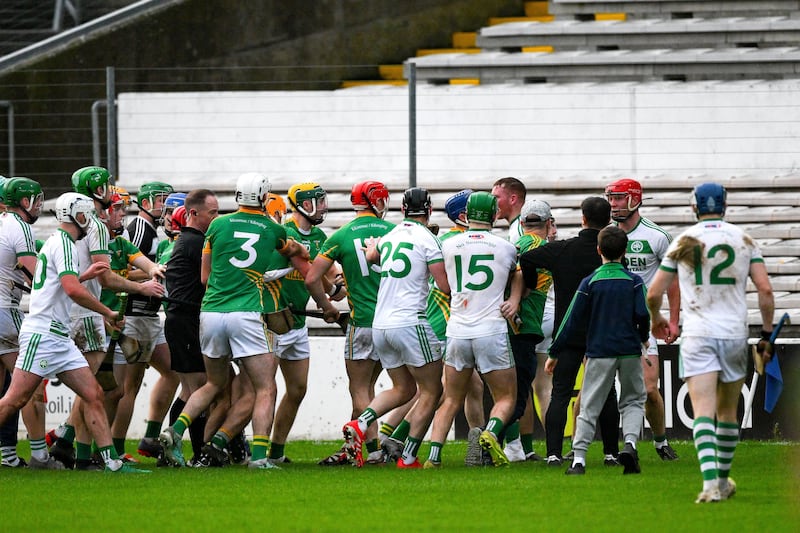
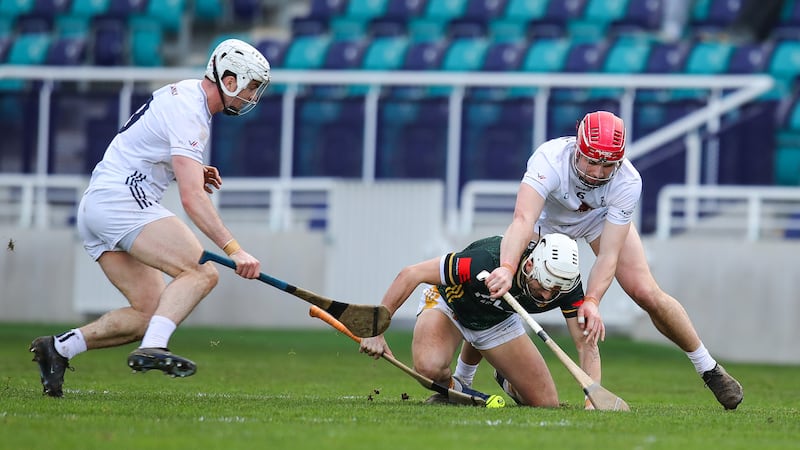
Just before the final whistle of the Ballyhale Shamrocks-Kilcormac-Killoughey Leinster SHC quarter-final sounded in Nowlan Park on Sunday, Charlie Mitchell clipped Adrian Mullen with his hurley and Mullen went looking for a dollop of retribution.
Players from both sides subsequently got involved in an altercation before all hell broke loose, before a Kilcormac-Killoughey (KK) supporter ran onto the pitch and punched Mullen in the faceguard.
When the individual was eventually hauled up from the bottom of a ruck, he picked up a hurley and motioned to swing it until KK full-back Jordan Quinn restrained him.
The man in his 40s was escorted back to the stand, before being later arrested by Gardaí. After being charged, the individual will now appear in court.

The disgraceful act besmirched a good performance from one of the most talented young teams in Leinster. The Kilcormac-Killoughey club subsequently released a brief statement before then having to quickly reword it.
After initially speaking about the defeat and the team’s impressive feat of winning three county titles in-a-row, along with securing seven Offaly titles in 14 years, the club made a brief reference to the post-match incidents: “As a club we do not condone the behaviour that was seen today by both sides”.
As well as pointing the finger at Ballyhale for the melee, KK’s statement did not address the core issue around the despicable and inexcusable behaviour of one of their own supporters.
After a growing adverse public reaction, the statement was amended: “As a club, we do not condone the behaviour that was seen today”.
Their initial line smacked of avoidance of a serious issue involving one of their own club people, who has form around crossing the line.
He was banned for 24 weeks in September 2024 as a result of a junior hurling fixture where he had been a linesman.
That clearly didn’t prove to be enough of a deterrent, but the reason supporters too often feel that they can cross the line and physically attack a player, referee, official, backroom member, or opposition supporter is because the GAA community tolerates too much.
For too long now, the GAA has baulked at heavy penalties, looking instead for excuses or seeking mitigation when the focus should be at the complete opposite end of the scale.
The primary focus should be on accountability and the proper sanctions.
Not enough is being done to alter the culture.
Initially, there will always be the early outrage, where decisive action will be promised but rarely followed through to the desired level to act as a sufficient deterrent.
It’s absolutely unacceptable to say that stuff happens “in the heat of championship”.

That attitude, and a tolerance of that attitude, is why so many of these incidents keep happening.
The only way to deal with such a rotten culture is to root it out with the heaviest sanctions possible – punching or assaulting someone should result in a minimum five-year ban from the GAA, possibly even stretching to a lifetime ban.
That would certainly make someone think twice before they physically attack somebody on the pitch again.
The GAA have to set those rules in stone and close all the loopholes which exist around avoiding, or reducing, serious sanctions.
There isn’t any point in a disciplinary committee recommending serious punishments unless the county board has the courage and conviction to endorse them.
This problem is deeply embedded across all levels but the GAA still need to be far more proactive on developing the culture required to weed the malaise out from the roots.
The GAA’s ‘Give Respect - Get Respect’ programme is an admirable initiative aimed at improving that culture but it’s still effectively only a two-page document handed out to the clubs that asked to sign up to it.
Yet there’s no real sanctions if people don’t adhere to the recommendations in the initiative.
As a result, the GAA ends up consistently going back to the rulebook, which, everybody knows contains a large number of loopholes.
That fuses black and white into grey but there can’t be any grey areas around something this serious.
Just as importantly, there can’t be any sympathy on this matter either because emotion only clouds the bigger picture.
An example must be set that will be followed elsewhere.
The consequences for those who attack match officials, players, opposition management or supporters must be absolutely severe.
Clubs must also take greater responsibility on this issue by adopting a zero-tolerance approach insisted upon from the top down.
That has to start with increasing the respect given towards referees and match officials.
Managers and coaches largely set the tone but if players, managers, coaches or backroom members, even supporters, are verbally abusing referees in an aggressive manner, club officials should insist that internal sanctions will apply to them.
Not every club will be that brave but culture is a collective responsibility.
If somebody within a club has a track record of verbally abusing referees at matches, or the opposition players and backroom, the club should be big enough to haul that person up before an internal disciplinary committee and punish them for their behaviour.
If that person is banned and still turns up at the club, or still goes to matches, the club cannot turn a blind eye.
Clubs have to place the greater good and the standard expected and demanded of anyone within that club ahead of loyalty or friendship.
It shouldn’t matter if that person cuts the grass, cleans the dressing rooms, sells more lotto tickets or coaches numerous underage teams in the club – any avoidance of dealing with the issue, or association with any kind of messaging around excuses, is absolutely irrelevant; the core message must still go out that such behaviour, which is ultimately a stain on that club’s name, will not be tolerated.
With a spark always waiting to ignite and combust into another blaze, the GAA need to adopt that zero tolerance approach to cure the association’s biggest cultural ills.