
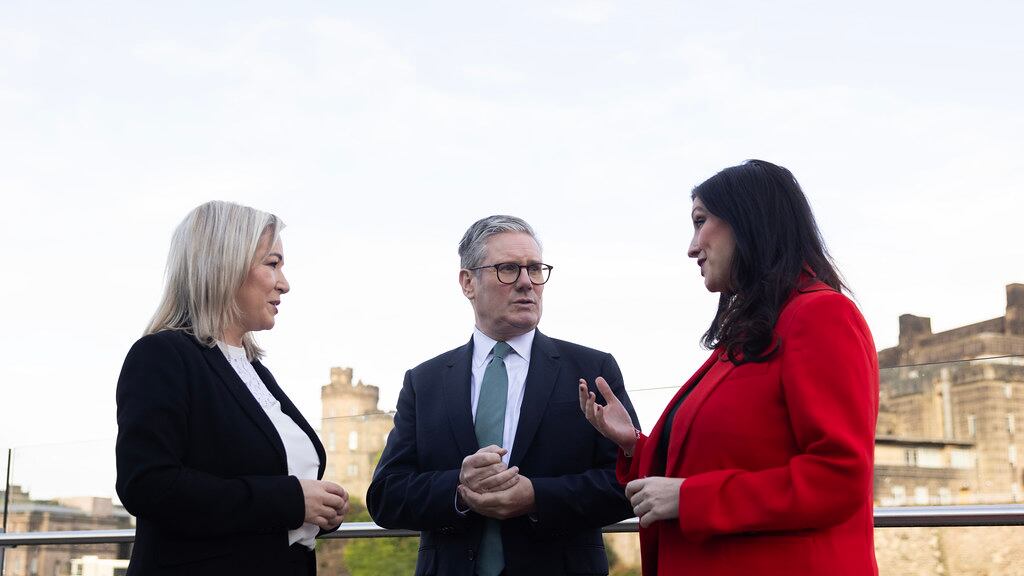
Bet you didn’t know the Council of the Nations and Regions of the UK (CNR) met on Friday.
Bet you don’t even know what the CNR is. Don’t worry. Most people don’t, and as a matter of fact most people, including many of those attending, don’t know what it’s for. It may be even the British government isn’t too sure.
In its terms of reference, the Cabinet Office says the CNR is “to facilitate partnership working between the UK Government, devolved governments, the Mayor of London, and mayors of combined authorities and mayors of combined county authorities.” That’s despite them all having different powers.
The Cabinet Office continues rather hopefully that its objective is to provide “engagement to ensure that governments and authorities with devolved responsibilities are working together to deliver on people’s priorities across the UK, ensuring the voices of the nations and regions are brought to bear on issues affecting the whole country”. Gobbledegook.
The genesis of the whole thing emerged from a plan Gordon Brown devised a couple of years ago to reform radically the House of Lords but which never made it into Starmer’s manifesto.
All these regions and devolved governments would nominate people who would produce a federal-based alternative to the unelected Lords.
There’s zero chance of any of that happening now or in the foreseeable future.
Much has changed since the CNR’s first meeting last October in the wake of Labour’s triumphant election victory.

Friday’s gathering was a far cry from that, with Reform UK having taken the mayoralties of Hull & East Yorkshire and Greater Lincolnshire and looking to add a few other scalps in the local elections in 2026.
Starmer’s talk of “partnership” and “collaborative government” no longer seems realistic.
Far from bringing together the fissiparous state of British politics and British devolution, the CNR looks as if it will be a forum for exhibiting those differences.
How is the devolved government of Scotland going to operate in “partnership” with Westminster? What will the relationship be between Reform mayors and the government of England?
When is Starmer speaking at the CNR as prime minister of the UK and when as head of government for England and Wales?
What has any of that got to do with here?
Contradictions and anomalies abound.
When it comes down to it, the CNR has no finances, no decision-making power, no permanent secretariat, no constitutional position.
It conflicts with the arrangements for Westminster’s relations with devolved government Michael Gove devised in 2022, which does have a secretariat. In short, the Council for Nations and Regions is a nothingburger.

Friday’s meeting got no coverage in the media because there was nothing to report.
You have to go the Stormont’s Executive Office to read a statement from Michelle O’Neill and Emma Little-Pengelly, in which they said they had met Starmer and talked about reducing barriers to trade between Britain and the north.
What’s that got to do with the CNR? Trade agreements are solely between the UK and EU.
What that statement illustrates is that First and Deputy First Ministers had nothing in common with the other ministers and mayors attending the pointless gathering. Why not? The north’s not in Britain, that’s why not.
That also raises the question, what was Michelle O’Neill doing at a gathering designed to strengthen and make UK government more coherent? There’s you thinking Sinn Féin wanted to leave the UK.
If SF won’t attend Westminster because they don’t want to interfere in British affairs, what’s the point in attending a charade about British affairs?
Perhaps one reason for attending would be to make a formal complaint about the increasing official use of the term ‘nation’ to apply to this place, as in one of “the four nations of the UK”. The word ‘nation’ implies a right to self-determination which the Good Friday Agreement guarantees to the people of “the whole of Ireland”, not just here.
The cabinet minister in charge of the charade, with the catchy title the Chancellor of the Duchy of Lancaster and Minister for Intergovernmental Relations, should find it easy to understand and respond favourably to such a complaint. He’s the Rt Hon Patrick Bosco McFadden MP, whose parents were native Irish speakers from outside Falcarragh. He’s also a Celtic supporter.
It might also be worth asking how the impotent CNR relates to the GFA’s British-Irish Council, admittedly also a talking shop, but part of an international agreement.
More importantly, why give credence to a Heath-Robinson contraption which diverts from the three interlocking relationships the GFA institutions created rather than to an internal exclusively British arrangement?
Being endlessly accommodating butters no parsnips. It’s not even as if there’s any money on the go.