
The Shakespeare play Much Ado About Nothing was in my mind last week when watching the Assembly shenanigans, which resembles more and more a Northern Ireland version of the Circus Maximus.
They were debating a fruitless motion of no confidence in the education minister, Paul Givan, over his visit to a school in Israel.
That the visit took place in part of the internationally recognised illegally-occupied territory of East Jerusalem simply fanned the flames of outrage.
The minister, as an individual, has an absolute right to go wherever he chooses. As indeed does everyone. He was never concerned about the opposition of his fellow Assembly members or even his government partners to his actions.


On reflection it probably was foolish to visit the school. Wiser counsel should have prevailed, as Givan has proven in the past to have a capacity to be both mature and measured.
Of course, in a normal democratic institution, it’s the right of the members to bring forward a motion of censure.
The north is anything but normal. The safeguards invented to protect the institutions also protect the members and, more importantly, the ministers.
Even the discipline exercised by the Speaker and the Standards Committee is so light-touch— it’s the political equivalent of the naughty step.
Givan relished the Opposition outrage, which forced his unionist frenemies in the TUV and UUP to row in behind his defiant grandstanding.

Of course, it suits Sinn Féin, the DUP, UUP, and Alliance not to look too cosy in the Executive. So a war of words every now and then is par for the course. Better a few barks at each other than take any actual bites.
And that’s what this is really all about – shadow boxing and soundbites rather than scalp-taking.
The minister, more emboldened than embarrassed, will now move on and, in a few weeks when memories fade, he’ll throw a few shillings or utter a cúpla focal at an Irish language initiative to keep some of his critics happy.
However well-intentioned or outraged, wasting precious Assembly business time on a motion which can physically go nowhere – when the Speaker has already ruled out a backlog of motions because of supposed legislative overload in the last 18 months of this Executive – is pointless.
A joint statement from each of the party leaders for or against the minister’s actions would have achieved exactly the same headlines.
Michelle O’Neill demonstrated courage and conviction by attending Remembrance events. She is following a well-trodden path by her predecessors in both Sinn Féin and, in fairness, the SDLP.
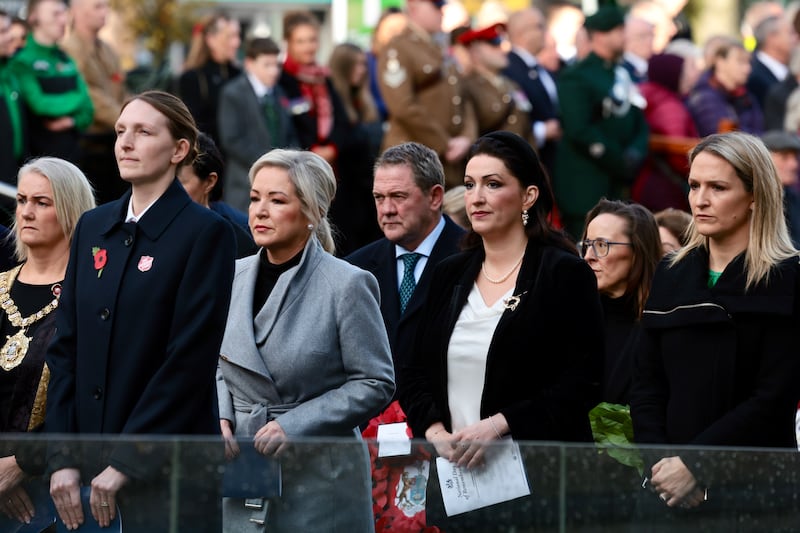
In a few weeks’ time, no doubt the First Minister will balance out her attendance at some commemoration for IRA volunteers, which will annoy victims and, of course, their non-nationalist Executive colleagues. Unfortunately, this is the outworking of our unique form of power-sharing.
The criticism aimed at Emma Little-Pengelly for non-attendance at the inauguration of new Irish President Catherine Connolly was, however, over the top.
Northern Ireland has a joint office of First and Deputy First Minister to reflect the communal divide, but it also means if, for reasons of political expediency or because there are conflicting or competing diary slots, sometimes they will out of necessity do things alone.
Remembrance events and the Windsor Castle commemoration of Armistice Day are important for the unionist community.
Sources say the Deputy First Minister did consider the logistics of fitting in all three events and flying from Dublin to London. If that is true, there was no offence intended or taken.
The DUP could have followed the UUP move and sent a representative to the inauguration. It was churlish of them not to. After all, Mike Nesbitt delegated the deed to Steve Aiken.
As Don John in Much Ado said: “Let me be that what I am and seek not to alter me!”
This applies to both First and Deputy First Ministers, and it may even apply to the new President.