A powerful surveillance tribunal is investigating whether the PSNI spied on one of the north’s most prominent solicitors and a colleague.
The Investigatory Powers Tribunal (IPT) examines complaints from people who believe they have been the victim of unlawful covert interference by state agencies.
It has now emerged that solicitors Kevin Winters and Barry O’Donnell have been excluded from an unprecedented review into the extent of PSNI spy operations because proceedings are ongoing with the IPT.
The review, headed by Angus McCullough KC, is focused on journalists, lawyers and non-governmental organisations, while the Policing Board and Police Ombudsman also fall under its terms of reference.


Mr Winters and his Belfast based legal firm, KRW Law, has been involved in some of the most controversial conflict-related cases in the north in recent decades.
It has now emerged that a case involving the two is being considered by the IPT.
As part of his review, Mr McCullough invited submissions from lawyers, solicitors and others who believed they may have been snooped on by police.
As part of the that process Mr Winters and Mr O’Donnell made submissions to both the review and the IPT.
Earlier this year Mr McCullough contacted the solicitors to tell them their submissions fell outside the terms of reference of his review as they were subject of ongoing proceedings at the IPT.
Mr McCullough has confirmed that his review received around 50 responses from a variety of individuals and on behalf of two organisations.
He added that a small number of the submissions, around five, fell outside his terms of reference.
Last year the London based tribunal found the PSNI and Metropolitan Police unlawfully spied on Belfast journalists Barry McCaffrey and Trevor Birney to identify their sources.
Mr Birney was represented by KRW Law.
It later emerged both men and a Police Ombudsman official had been spied on during a PSNI investigation led by Durham Constabulary, known as Operation Yurta, which was linked to the alleged theft of confidential documents used in a film about the 1994 Louginisland massacre.
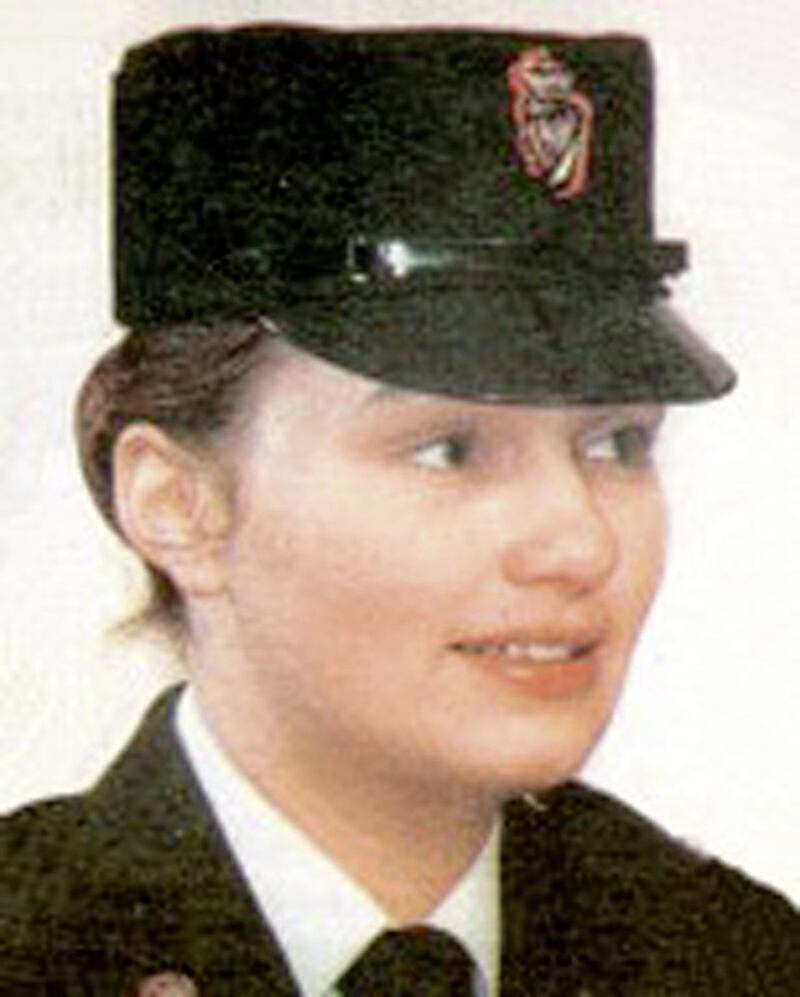
Durham Constabulary also investigated another alleged leaked document, as part of a second investigation known as Operation Tabist, which was linked to an IRA mortar attack that claimed the life of RUC officer Colleen McMurray (34) in Newry in March 1992.
The IRA attack is thought to have involved an informer.
It is understood a member of Mrs McMurray’s family later provided their legal firm, KRW Law, with a copy of the leaked document.
Ms McMurray’s widower Philip McMurray, himself a former policeman, and his solicitor Barry O’Donnell, of KRW Law, were later both interviewed by police in relation to the sensitive document.
Both men were informed by the Public Prosecution Service that it was not in the public interest to prosecute them.
It is believed the document confirms a second police informer was working at a senior level within the IRA in south Down in the 1990s.
The existence of the document emerged when a former official at the Police Ombudsman’s Office was arrested in Dartford, Kent by PSNI officers investigating the “suspected theft of sensitive documents from within the Office of the Police Ombudsman”.
The document later came into the possession of lawyers for the Ministry of Defence and PSNI as part of a separate case involving British agent Peter Keeley, who is also known as Kevin Fulton.
In 2015 Keeley told BBC Panorama that he helped design the technology used to fire the mortar that killed Ms McMurray.
He also said he had passed that information onto his handlers and told them the IRA was planning an attack.
Keeley has been linked to the death of Newry IPLO member Eoin Morley, who was shot dead by the IRA in April 1990.

In 2006 Keeley was arrested in England and questioned about the Morley killing and the death of British soldier Cyril Smyth, who was killed when the IRA carried out a bomb attack on a checkpoint outside Newry in 1990.
In 2014 Keeley was ordered by a court in Belfast to pay damages to Mrs Morley.
The Irish News understands that the secret document does not name the alleged second informer, instead the person is referred to by code.
It is believed an attached intelligence report refers to the second agent, who worked for Special Branch.
It is understood the document reveals the second informer was reporting to his handlers about the activities of Keeley.
A Police Ombudsman’s report into the Newry mortar attack published in 2021 failed to reveal details of the second informer believed to have been working inside the IRA in the area at the time.
In an update circulated by Mr McCullough last week he revealed that four out the potentially relevant submissions are outside” his remit “due to being the subject of ongoing proceedings” before the IPT.
Mr McCullough said he wrote to “wrote to the relevant individuals to confirm this” in May and “for those cases I have made a proposal that should enable them to be considered once the IPT proceedings have concluded”.
Mr Winters said his case and that of Mr O’Donnell are among that number.
Solicitor Kevin Winters asked the PSNI to “confirm whether or not our practice was the victim of targeted surveillance”.
That request was “subsumed” into the McCullough Review and at the same time “two bespoke applications” were made to the IPT to “investigate our suspicions on wider state surveillance in specific conflict-related litigation by our office”.
“Last year following the out workings of litigation brought by two journalists, myself and another colleague, Barry O’Donnell, filed applications with both The McCullough Review and the IPT to find out if we were surveilled by the PSNI and other state agencies,” he said.
“We has an overriding suspicion that we were spied on given the timing of events linked to PSNI investigations into our legal work and investigative journalism respectively.
Mr Winters said that in 2017 his firm filed a High Court motion “alleging state collusion in the 1990 PIRA murder of Eoin Morley”.
“This triggered an injunction application by PONI (Police Ombudsman) and was also the catalyst for an immediate criminal inquiry by PSNI and Durham Police who took a strategic decision to thematically link their investigation into the use of certain PONI documents in both conflict-related litigation and investigative journalism,” he said.
The solicitor said the McCullough Review later advised that the IPT “would have to investigate our applications”.
“Given the legal density and sensitivities of the tribunals’ work we have to respect their position when they tell us it’s not their practice to issue updates on any cases,” he said.
“However, in saying that we are concerned the NIO (Northern Ireland Office) have taken an inordinately long period of time to advise us on where they are on disclosure.”
The Northern Ireland Office said the matter was one for the Home Office.
A spokesman for the PSNI said: “There is no commentary planned until the publication of the (McCullough) report on Wednesday.”