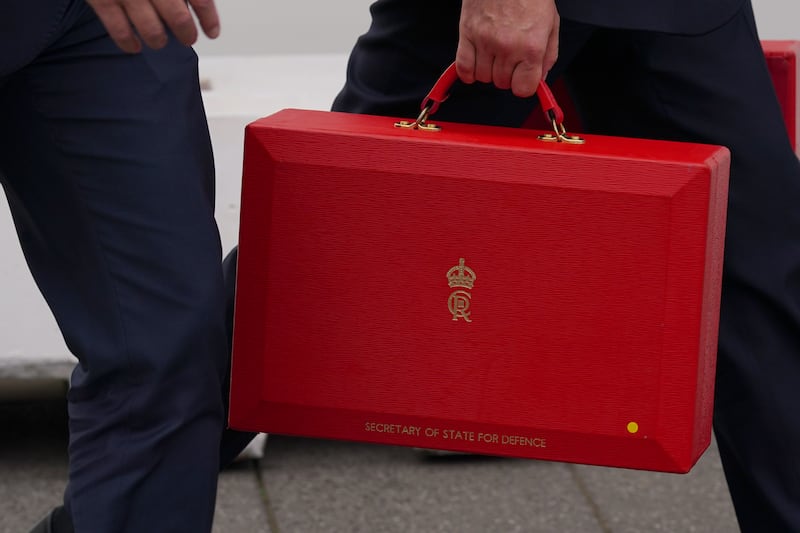
Following a torrent of leaks and unattributable media briefings much is already known about next Tuesday’s 2027 budget package.
Tánaiste Simon Harris announced a few months ago that the size of his first budget as finance minister would be worth €8.5 billion.
As is customary, Harris used the so-called Summer Economic Statement to outline his plans.
The budget for next year will include additional spending of €7bn, and a tax package of €1.5bn mostly designed to increase income tax reliefs.


The Summer Economic Statement was brought in by the Department of Finance about a decade ago to put a framework around budget decision-making.
The publication comes in late July before officials and government politicians head off on their holidays.
It has also become something of a launch date for well informed speculation and leaks long before the official unveiling of the budget measures in October.
Most special political advisers and government ministers appear to have joined in.
Pre-budget disclosures are favourable to the Fianna Fáil and Fine Gael-led coalition.
Tax measures through tax credits or widening of bands are presented as “giveaways” to key blocks of voters.
Not much thought is given to whether over €1bn in tax measures will have any significant effect when inflation is taken into account.
The media stories also promise relief to the taxpayers in mysterious parts of the land called “Middle Ireland”, while other sections of the population are referred to as the “Squeezed Middle”.
Stories about increases in pensions and social protection payments will exclude discussion about less affluent households having more to lose from soaring grocery and heating bills.
And the leaks keep coming.
The budget will also feature a measure for 16-year-olds to get a €100 voucher to spend on live music gigs, cinema and other cultural outings.

Patrick O’Donovan, the Minister for Culture, Communications and Sport, will reportedly detail how the scheme will work next week.
Leaks are nothing new.
“This government has debased the budget process through its extreme manipulation of figures in policy of always hiding the negatives,” Micheál Martin told the Dáil on budget day, in October 2015.
“After six months of hype and daily stories planted in our newspapers the sum of what has been announced is a cynical budget full of inflated claims which are already unravelling,” Martin said at the time.
The Fianna Fáil leader was then in opposition, but the countdown was already underway to an election that would officially be called for early in 2016.
Martin is now Taoiseach and leads a coalition which faces few financial constraints, as record levels of tax revenues continue to flow into the exchequer.
Harris has said his 2027 budget will be smaller by a few billions of euros than the package presented a year ago by his predecessor Paschal Donohoe.
Donohoe has since left the government for a senior post at the World Bank in Washington.
At the Oireachtas Budgetary Oversight Committee last week, Harris and Public Expenditure Minister Jack Chambers again pledged their commitment to sound budget management.
The budget will strike a balance between necessary measures to help households with their energy bills, but without harming the health of the public finances.

Harris said there was a strong argument for raising tax bands and tax credits to compensate income earners for inflation.
For his part, Chambers said the government needs to do more to get value for “every euro spent”.
This was in the context of the official forecast that total government spending would rise to €125.5bn in 2027.
As the Summer Economic Statement outlined, annual spending would increase by €7bn, or by almost 6%.
Total spending will include €105.2bn on so-called current spending and €20.3bn on capital spending.
John Healey, the new British Labour Chancellor of the Exchequer, can only dream that he could tap similar budget resources.
Preparing for his first budget later in October, Healey faces deeply troubled British finances.
Bond markets are also ratcheting up pressure on London for new rounds of austerity that are euphemistically referred to as “reforms” on social welfare spending.
But back on this side of the Irish Sea, regulators and watchdogs remain to be convinced even as Harris talks about sound finances.
“Higher energy prices have added significantly to headline inflation in 2026 as the Iran-US war has pushed up international energy prices,” the Central Bank warned in its latest bulletin last month.

“Along with these externally determined price pressures, domestic services inflation remains elevated.”
The Central Bank wants Harris to stick to his budget sums set out in July.
“To avoid stoking existing inflationary pressures, the expenditure ceilings in the Summer Economic Statement should be adhered to in the forthcoming budget,” the regulator said.
It again pointed to the billions of revenue flowing into the exchequer and warned that exceptional levels of profit taxes from the tech and pharma multinationals cannot be relied on to continue to flow forever.
And it wanted the government to follow the advice it has long ignored.
Global inflation soared in recent years following the economic rebound from the Covid crisis.
It was stoked by the Russian invasion of Ukraine and now faces new pressures following the attacks on Iran by the US and Israel this year.
“For households particularly exposed to the effects of higher energy prices, temporary and targeted measures can protect the most vulnerable while still ensuring that the overall budgetary stance builds resilience in the public finances,” according to the bulletin.
In August, the Irish Fiscal Advisory Council (IFAC) was blunter still.
IFAC was set up after the financial crash to provide “an honest and independent assessment of how the government is managing the public finances and the economy”.
But the Irish economy is already growing strongly and doesn’t need the government to hike spending by almost 6%.
“The government’s plans for budget 2027 are slightly larger than what the council would deem appropriate but the bigger concern is that the actual budget package is likely to be much larger than what is announced on budget day,” warned the IFAC chair Séamus Coffey.
“Spending overruns have become routine and have repeatedly pushed spending above budget-day plans.
“Over the past decade, spending overruns have averaged more than €2bn per year in today’s terms. The last time spending was at, or below, budgeted levels was in 2013,” Coffey said.
With no powers, the budget watchdog can only urge the government to take the right course.

It wants Harris to run large budget surpluses, save more of the huge receipts the exchequer is tapping from corporation taxes, and to continue to fund two savings or sovereign wealth funds.
By the end of August the government had already collected enormous resources this year of over €66bn in tax revenues. Almost €18bn of the revenues were sourced from corporation taxes alone.
And exchequer figures for September released before the budget for the first nine months of the year will also likely show further strong returns from income tax revenues and VAT.
But observers warn that the exchequer’s booming fortunes is setting up the government to become hostage to more large interest groups.
The hauliers’ protests over diesel excise duties this spring brought slow moving coveys onto motorways and tractors into Dublin city.
Ireland’s only oil refinery in Cork was blockaded.
The government settled the dispute by cutting excise duties on fuel, but at an annual cost of €800m in lost revenues to the exchequer.
Leaks ahead of next week’s budget will do little to calm demands from interest groups for even larger spending.