It’s been a long road for Bhóthar na bhFál (Falls Road).
Breis is 20 bliain in the making, ach faoi dheireadh thiar thall (but at long last), bilingual signage is appearing along Bóthar na bhFál.
For the Ceathrú Ghaeltachta Bhéal Feirste (Belfast’s Gaeltacht Quarter), acquiring bilingual signage has been no small feat. The renewed controversy surrounding the Garvaghy Road provides an important context for understanding why the use of language on public signs can be so sensitive.
While the two issues are substantively different, both demonstrate how public space can become a vehicle for competing expressions of communal identity - and how something as seemingly ordinary as a street or road sign can carry meaning far beyond the words on it.
In 1995, a statutory policy gave Comhairle Cathrach Bhéal Feirste (Belfast City Council) discretionary powers to erect dual-language street signs in a language other than English. Implementation was delayed for three years because of resource implications, with the policy eventually agreed in 1998.
Under that system, an application had to be supported by a petition from one third of the residents of the street before a formal consultation could take place. For bilingual signage to proceed, two thirds of those consulted had to give their support.
That threshold made the process daunting.
Between 1998 agus 2019, there were just 269 applications.
Then, in 2022, came a significant change in policy. The policy now means at least one resident of any Belfast street, or a councillor, is all that is required to trigger a consultation on a second nameplate.
If 15 percent or more of all occupants surveyed in a street want to have a dual language sign in the language requested, this will be sufficient to erect the sign.
The effect was dramatic. More than 500 requests were received between July and October alone, a sharp increase on the numbers generated under the previous system.
For years, there had been a campaign for bilingual road signs across the Ceathrú Ghaeltachta Bhéal Feirste. In 2023, Comhairle Cathrach Bhéal Feirste formally agreed to proceed with a scheme covering the area.
Some 8,887 addresses were identified, all of which were to be consulted.
The result was that bilingual Irish-English street nameplates could proceed on 301 streets where objections had not reached the agreed 15% threshold, a departure from the usual rule where 15% of occupants agreeing to the sign lead to its installation. One street, Clovelly Street, exceeded that objections threshold and therefore required a fuller survey.
The story of bilingual signage in west Belfast, however, goes back much further.
In 1999, Comhairle Cathrach Bhéal Feirste agreed to a bilingual welcome sign at the entrance to Falls Park.
By 2016, Translink reported that buses operating along the Metro 10/Falls Road corridor were displaying bilingual English-Irish destination information.
Each development represented another step in the normalisation and visibility of Irish in the public realm.
Then came the Falls Road pilot.
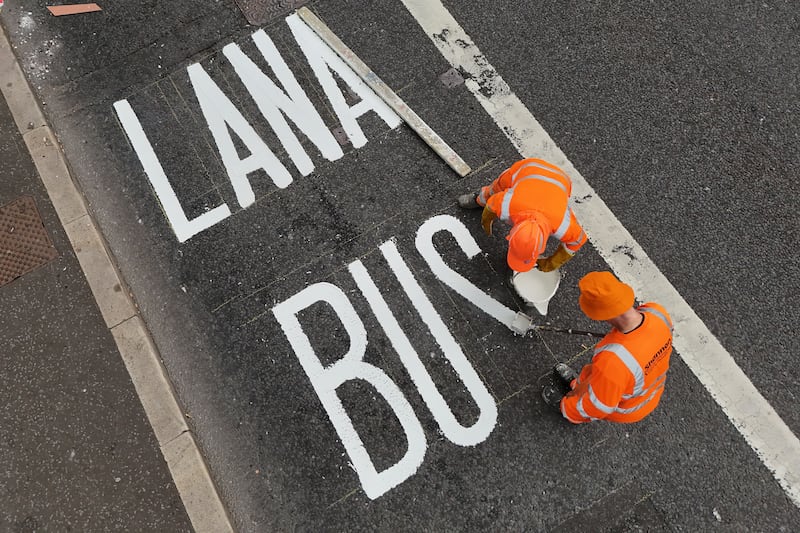
In October 2024, the then Infrastructure Minister, John O’Dowd, announced a scéim phíolótach (pilot scheme) to introduce bilingual traffic signs along parts of Bóthar na bhFál.
The pilot identified 93 upright traffic signs and 35 worded road markings for bilingual treatment.
The scheme did not emerge in isolation. It was the product of a longer process: decades of community campaigning, changes to Belfast City Council’s approach to bilingual street signage, the wider statutory recognition of the Irish language, and a growing emphasis on area-based language planning.
In July, the first bilingual road signs i dTuaisceart na hÉireann (in the North of Ireland) were erected between Springfield Road and White Rock Road.
Now, Infrastructure Minister Liz Kimmins has asked officials to assess extending the scheme along the entire length of Bóthar na bhFál within the Ceathrú Ghaeltachta.
There is still work to be done. Tá obair le déanamh fós. Officials will have to examine the existing signs, design new ones, identify funding and plan the works. It could take several months.
But the next stage of the campaign for bilingual signage may now be on its way.
And that is perhaps the most significant change of all.
What began as individual community requests for individual streets has gradually developed into something broader: a strategic approach to language planning across an established Gaeltacht area.
Is athrú suntasach é sin. It is a notable change. From Irish on one small sign, to now Gaeilge being a natural part, mar chuid nádúrtha de shaol poiblí na Ceathrún Gaeltachta, of public life in the Gaeltacht Quarter.
After all, it’s been a long road do Bhóthar na bhFál.
Cúpla Focal
Bhóthar na bhFál (Falls Road)
ach faoi dheireadh thiar thall (but at long last)
Ceathrú Ghaeltachta Bhéal Feirste (Belfast’s Gaeltacht Quarter)
Comhairle Cathrach Bhéal Feirste (Belfast City Council)
scéim phíolótach (pilot scheme)
i dTuaisceart na hÉireann (in the North of Ireland)
Bóthar Chluanaí (Springfield Road)
Bóthar na Carraige Báine (White Rock Road)
Tá obair le déanamh fós. (There is still work to be done.)
Is athrú suntasach é sin. (It is a notable change.)
mar chuid nádúrtha (as a natural part)
de shaol poiblí na Ceathrún Gaeltachta (of public life in the Gaeltacht Quarter)