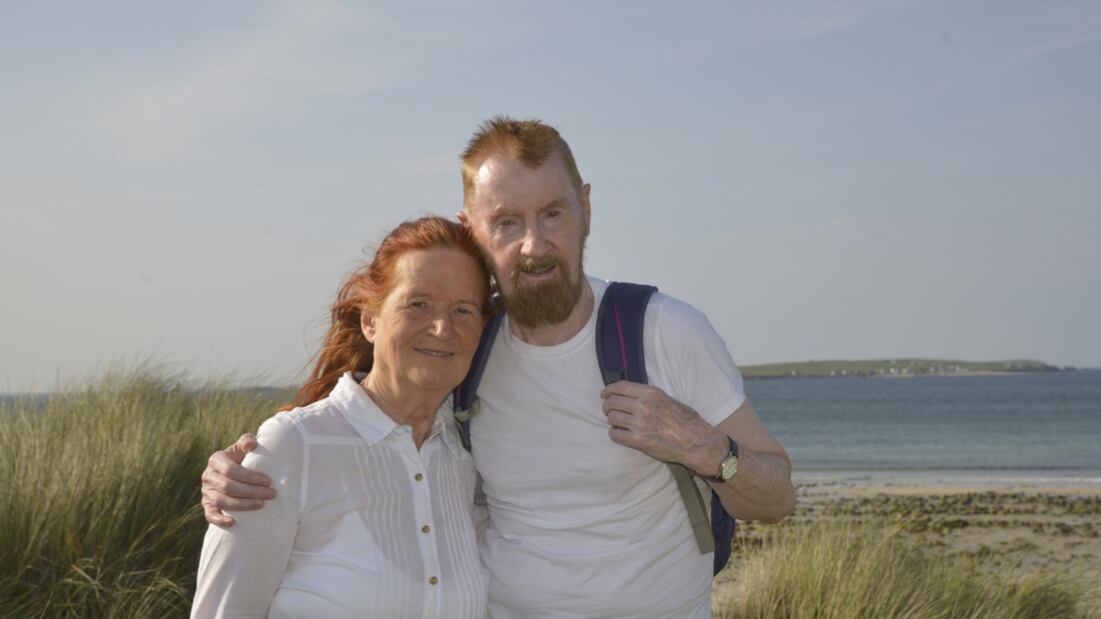
A Donegal-based couple at the centre of the fallout from the 1994 Heathrow mortar attacks have published a memoir telling “their side of the story.”
In March 1994, the Provisional IRA launched three mortar attacks on Heathrow Airport over the course of five days. While no one was injured, the incident caused significant disruption and millions of pounds worth of damage.
For Michael Gallagher and Mary Attenborough, who now live in Falcarragh, Co Donegal, it marked the beginning of what they describe as a “harrowing” journey through the British justice system, which they have chronicled in their new book, Unbroken: Secrets, Lies and Enduring Love.
“Michael has always been a great writer,” Mary tells The Irish News.
“And when he got out of prison he started writing a fictional account of everything that had happened, but I felt it lacked some of the emotion.
“So, because he was basing it on our life and our experiences during that time I decided to come in on the project and help him write it as a memoir, and luckily we made it to the end,” she laughs.
Read more: From the blanket protest to the page: Ex-H-Block prisoner Malachy Trainor shares his story

In October 1996, armed police raided the couple’s home in Earl’s Court, London, and arrested Michael as it was believed he was involved in the attack on Heathrow.
In the memoir, Michael, who is Glaswegian but has family roots in Claudy, Co Derry, writes that initially he didn’t realise his arrest was linked to the Heathrow attacks, assuming too much time had passed. It was only during police questioning that the connection became clear.
However, he maintained his innocence throughout his time on remand and during the high-profile six-week trial that followed.
Meanwhile, Mary launched into a campaign to prove Michael’s innocence, believing he was the victim of a miscarriage of justice similar to those suffered by the Birmingham Six and the Guildford Four.
It wasn’t until his conviction at Woolwich Crown Court that she discovered the truth.
“I protested my innocence even though I knew I was guilty,” says Michael, who was described as an IRA ‘fixer’ during his trial.
“But the thing is, once I was arrested, I couldn’t tell Mary – I just couldn’t do it. I couldn’t risk involving her, especially after she’d gotten various friends and family members to put up more than £250,000 in bail sureties.
“If I had told Mary I wasn’t innocent, my defence would have collapsed completely, and I would’ve had to throw myself at the mercy of the British courts, and I wasn’t going to do that.
“And that’s one of the reasons I wanted to write the story, because I felt Mary’s position was a bit ambiguous to a lot of people and I needed her to be vindicated and make sure people knew that before I was convicted, she didn’t know about any of it.”

Mary admits when Michael was convicted and revealed to her that he was in fact guilty, she thought she would have to end their 11-year relationship, but she ultimately chose to stand by him.
“We first met through an anti-apartheid group and then again when we went to support the miners’ strike in the 80s and we just got on,” she says.
“We had a similar stance on politics and a similar sense of humour and after a while we were inseparable. We still are. We spend a lot of time together.
“So even though my friends were telling me to leave him I just couldn’t bring myself to do it. It would’ve been like cutting my arm off, I was so in love with him.”
In the book Michael explains that the mortars weren’t armed to explode, as the attacks were purely symbolic, coinciding with the debate in the British Parliament for the renewal of the Prevention of Terrorism Act.

However, despite this, he was sentenced to 20 years in prison for conspiring to cause explosions, initially being sent to Belmarsh, a category A prison nicknamed ‘Hellmarsh’ due to the high number of reported physical and authority abuses.
“The special secure unit at Belmarsh was very stifling and eerie. It felt almost cave-like at times because I couldn’t get a clear view of the sky,” recalls Michael.
In the book he references the “dehumanising” treatment he experienced from prison officers conducting invasive searches, which he believes were meant to “degrade and humiliate” prisoners.
Although he confesses that his time in prison “could have been a lot worse.”
“I went on to a main prison wing which was also high security, but it was like a cathedral. It was three stories high and there was a lot of light and it was a completely different experience.
“It was really noisy, you couldn’t get any peace, there was always shouting and late-night music and you couldn’t sleep so you’d try to join in.

“I actually remember recreating the cell block scene from Jail House Rock at one point. But that was prison, there was good and bad, but you made the best of it.”
The couple agree that writing the memoir, which tells the story from both Mary and Michael’s perspective, gave them a newfound understanding of what the other went through during that time.
“Whenever Michael was in prison he always looked on the bright side, like he’s doing now. He would’ve told me it was like a holiday camp,” Mary explains.
“And that always surprised me, especially when he was in Belmarsh because it was so well known for how horrendous it was, and I could never understand why he didn’t want to do more and campaign about it.
“I only realised when we were writing the book just how bad it had been for him, and the reason he’d kept it all quiet was because he didn’t want to upset me.”
In 1998, Michael was transferred from Long Lartin High Security prison to Portlaoise and under the terms of the Good Friday Agreement was released in July 2000.
Read more: Belfast Oscar-winner Terry George: ‘The Tunnel is a snapshot of a pivotal moment in the Troubles’

Following his release, the couple, now reunited, moved to a cottage in Donegal and set up a web development business.
“The GFA was like a miracle. It was just miraculous that we could be together again,” adds Mary.
Reflecting on the 25 years since Michael was released, the couple say committing their story to print has been “incredibly cathartic.”
“I think that really helped us,” says Michael.
“It’s created new things to discuss and since it’s been published the response from people has been really positive, so long may it continue.”
Unbroken: Secrets, Lies and Enduring Love by Mary Attenborough & Michael Gallagher (Merrion Press) is available now.