One of my abiding memories is of the night I spent in the British Legion Hall in Stornaway on the Isle of Lewis in the Outer Hebrides.
I was in the Outer Hebrides for Feis Cheilteach Innse Gall or The Hebridean Celtic Festival and that evening was spent in a huge marquee heaving with people who were there for bands such as Shooglenifty. the Peatbog Fairies and the mighty Runrig.
And the entertainment didn’t end in the marquee. No, away off to the Legion Hall with us where a multitude of musicians had gathered, happy to further entertain the assembled lads and lassies with a rip-roaring céilí.
It might be hard for some people on this side of the Straits of Moyle to imagine a céilí and Gaelic being freely spoken in a British Legion Hall but of course, Scotland is different to this part of the world.
On a guided tour around Lewis and Harris the previous day, I was astonished to see the number of monuments to islanders who had fallen in the Great War.
I saw the same thing on the Isle of Skye - monuments, plaques, gardens of remembrance, commemorative stones with the names of the young men who had perished in far-off fields.
147,609 Scots were killed between 1914 and 1918 during the First World War a fifth of British War casualties at a time when Scots made up 10 per cent of the population.
In a very interesting article (in Irish) about militarism in Scotland, Prof Alan Titley says that it is estimated that a quarter of Scottish men saw military service between 1792 and 1815 and that that mindset has remained ever since.
Even as late as the unfortunate escapade in Suez in 1956, the Scots were stronger in favour of military action than the English.
I believe that that same mindset pertains amongst what is known as the PUL community.
Reading tweets from members of the PUP, for example or the Orange Order or of individuals within that community, you will see how important past military events are, especially the World Wars.
The Somme is as alive and well today that you would think it happened last year. I'm not critiscising this, just mentioning it.
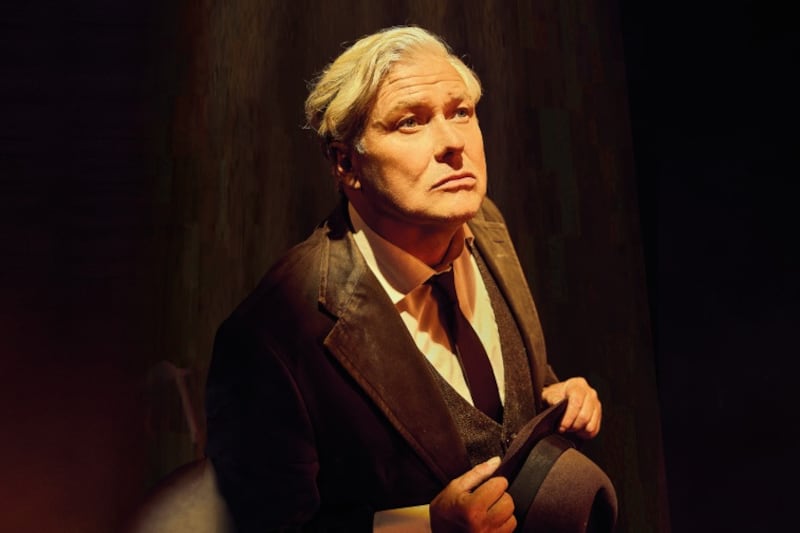
Perhaps people would have a different opinion after watching Sequamur, a play in Scots Gaelic which was performed at the Belvia Players Theatre as part of the EastSide Arts Festival in east Belfast.
Written by Donald S Murray, Sequamar tells about the Rector of the Nicholson Institute in Stornaway on the Isle of Lewis, William John Gibson.
Full of the grandiloquence of classical poetry, Gibson’s soul is full of noble thoughts and ideas which lead him to inspire his pupils to go and fight for a New Britain during the First World War. And many of them took his advice.
But gradually, as stories of the horrors of what is happening on the battlefields of Europe reach GIbson, and how many of the young men he encouraged to enlist were being killed, the inspirational headmaster falls into despair.
There are scenes in Sequamur (Latin for "Let us Follow") when the ghosts of the dead soldiers/teenagers, come back to torture Gibson because of his role in their slaughter.
Yet, letters to Gibson from soldiers in the trenches are read out during the play and it’s obvious that he was held in high esteem and was well liked by his pupils.
There is a very strong scenes at the end when Gibson has to unveil a plaque in the school which contains the name of the past pupils who never came home, young men he personally knew and whose education was his duty but now they lay beneath the sod in a foreign cemetery.
However, some names were missing from the plaque, the ultimate tragedy.
Some survivors come back to shower him with accusations and damn the high-minded poetry which sent them to their deaths. The words of Aristotle, “We make war that we may live in peace,” means nothing to them now.
Sequamur is a great play, moving, powerful with a message that resonates today.
The acting was first class from Daibhidh Walker, Iain Beggs, Donna Mhoireasdan, Sean McLeod and Angus Padraig Campbell.
At the end, piper Angus Nicholson movingly played a lament as the names of the 148 pupils who died in battle in the Dardanelles and in Gallopoli and in other places rising above us.
Huge thanks to the EastSide Festival for daring to stage this wonderful drama.