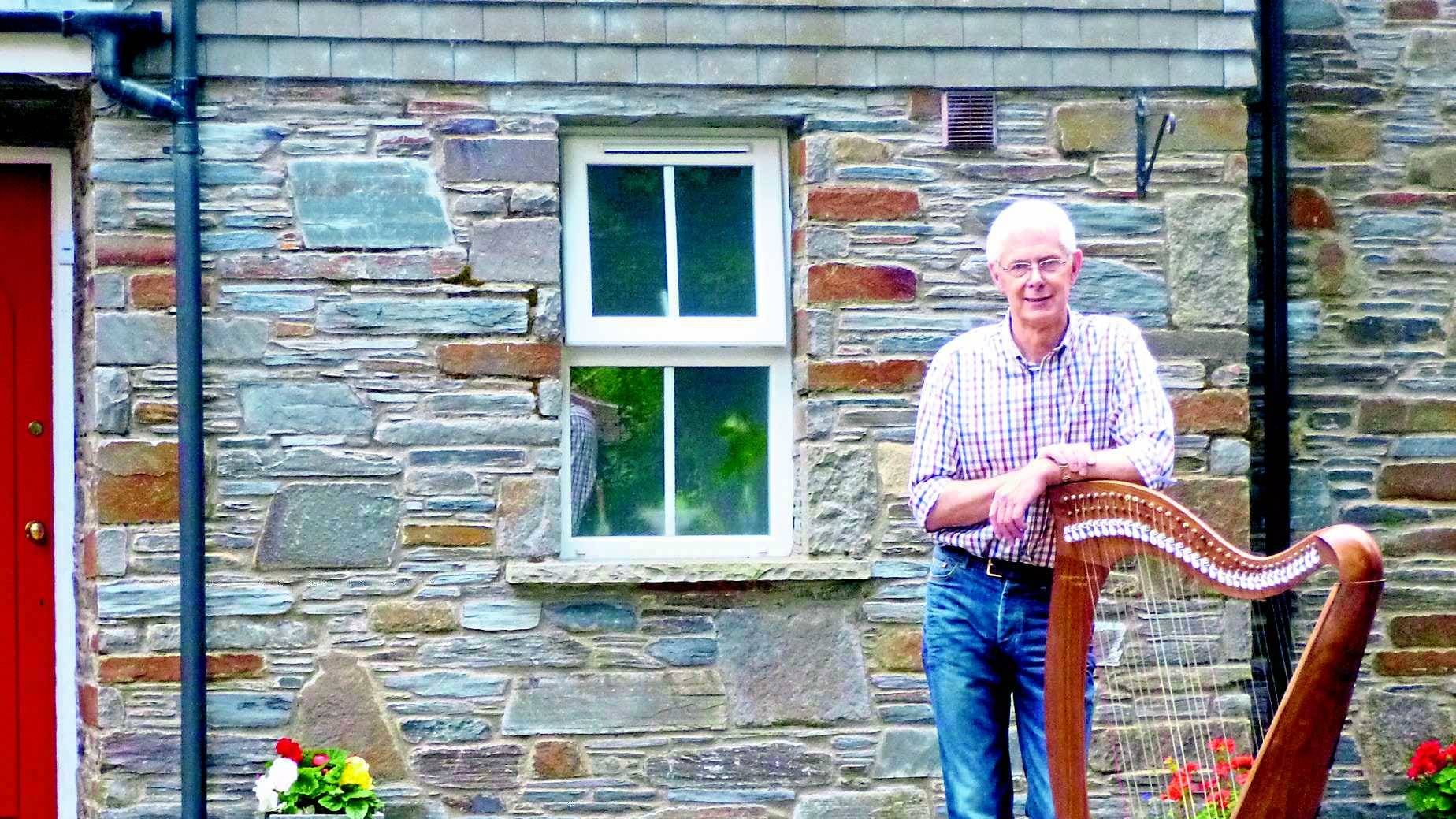
HE MAY not bring his harp to a party but many people do and they are always asked to play.
A Turmennan harp is a much sought after instrument because it's made with love and care by Mervyn Waugh in his workshop near Crossgar, Co Down. By any stretch of the imagination he's a remarkable man.
He is gifted with an ability to build anything from a dry stone wall to a coach house with a clock tower on top, from a Celtic harp to an aeroplane. He's a man with a passion, be it violins, violas or guitars, cabinet making or carving rocking horses for his grandchildren.
When he moved into his Co Down home some years ago he began building a new kitchen, fashioning the furniture, cupboards and drawers, tables and chairs; throughout the house are examples of his work, beautifully made. But more than that, by using any number of woods, the grains make fascinating patterns.


Outside I admire the clock tower and asked where on earth did he find such an item. "I made it, the clock came from TK Maxx and runs on battery," he laughs.
You may assume that this craftsman is a professional at his trade but that's not so.
He began his career in the BBC in London, working on radio programmes. He then came home to work in Ulster Television in 1968, first on cameras and then directing but he always loved the challenge of working with his hands and fashioning works of art.
At that time he and the family lived in Finaghy and it was there that he made his first 'signature' piece, a single seat Clutton Fred, a small sturdy plane named after former RAF officer Fred Clutton. During the 1970s Mervyn flew Fred from Newtownards airfield all round the North, dressed in leather flying jacket and goggles: "An open cockpit so you could smell the grass."
Exhilarating stuff. He made a second plane which he sold and his prototype he donated to the Ulster Aviation Society Heritage Centre.
Mervyn has also made violins based on the Guarneri and Stradivari family designs and he showed me the dulcimer he will be finishing soon. This man doesn't know what to be at next. Today, however, he is embracing harp-making. His Turmennan harp is of medium size and made to be carried just as in times gone by when musicians travelled round the countryside entertaining people. It even comes with a stout carrying case, all included in the price, which starts at around £2,000.
His inspiration came at his daughter's wedding, when two harpists played at the ceremony; afterwards he took a closer look. "They intrigued me and I decided to try making one. It looked like a harp but it didn't play like a harp so it was cut up for firewood and I got to redesigning. The next was quite successful and I called it Turmennan Aine after the townland here and my wife.
I now have a second design, the Turmennan Eala - Irish for swan and reflecting the swan's wing in the design."
Whereas a concert harp can be six feet tall with over 40 strings and pedals, the Turmennan folk 'lever' harp is around four feet high.
The principal parts are a hollow sound box, strings and a front vibrating sound board. Mervyn uses sitka spruce from northern Canada cedar from European countries, all accessed through a boat yard in the south of England - where they make yachts using the sitka spruce for the mast because it is strong for its weight. The wood arrives at Crossgar in planks and this is where the transformation begins; making the frame and then the skilled job of fashioning the harmonic curved fore-post usually in walnut or maple, sometimes cherry. "The bass strings in the Eala are made to my specification by a specialist string maker in America. Other strings are Savarez fluorocarbon, sometimes known as synthetic gut or simply carbon," he explains for the experts, adding: "All my harps come fully levered with Camac levers."
It takes about 10 weeks to make a single bespoke harp, although not every day is suitable for working the wood in the workshop, especially if it's too damp or too cold - for this reason there are traces of harps all over the dining room! "It's a hobby, not a commercial venture" Mervyn tells me. "I make them mostly for teachers or musicians and it's a joy to hear them played."
Although Mervyn can pluck out a tune with two fingers, students at the East Antrim Traditional Music School make his harps sing. "A great quality instrument and great value," says Martin Shane, who started the school 10 years ago. It provides classes for all ages and skill levels for a variety of traditional Irish instruments - fiddle, tin whistle, flute, guitar, mandolin, bodhran and, of course, the harp. He rates the Turmennan as excellent. "You can't knock out an instrument like this on a commercial basis, it needs time, patience and passion and this is evident in Mervyn's harps; we love playing them."
* For more about Turmennan harps and the music school, visit Turmennanharps.com and Eatms.co.uk.